
Smart lifting magnets and integrated sensor technology open up new possibilities for predictive maintenance in industrial automation.

Solenoids 4.0: How Predictive Maintenance Prevents Downtime in the Smart Factory


Alexander Grischin
Sales Manager
Quicklinks
- Smart lifting solenoids in Industry 4.0
- Integrated sensors: the data source for predictive maintenance
- Networked solenoids in the IoT: real-time data and edge analytics
- AI-driven data analytics: detecting solenoid anomalies before downtime occurs
- Less downtime and lower costs: Impact on availability and TCO
Smart lifting solenoids in Industry 4.0
Modern Solenoids 4.0 have the potential for lifting classic electric solenoids into intelligent IoT devices. These smart electromagnetic actuators continuously collect condition data and help prevent costly downtime. In connected smart-factory environments, sensors and actuators communicate in real time to ensure optimal operating conditions—this is what makes predictive maintenance possible in the first place. The result: higher system availability and fewer unexpected failures.
Example: In an automotive assembly plant, for instance, numerous linear lifting solenoids are used on robot grippers and clamping devices. If an actuator fails unexpectedly, the entire production line comes to a halt—costs can run into thousands of euros per minute. At a German automotive supplier, existing solenoids were therefore replaced with smart solenoid solutions. Each electric lifting solenoid is equipped with sensors and reports its status to the control system. One day, the system detected a longer response time on a gripper solenoid and issued an early warning of a potential failure. The component could be replaced during a planned service interval—before any unplanned downtime occurred. Production continued without interruption—benefiting both system availability and on-time delivery performance.
Lesson: Smart solenoids significantly improve process reliability in highly automated environments. Decision-makers in production and maintenance should adopt Industry 4.0-capable actuators early to minimize downtime. Implementing predictive maintenance strategies not only increases equipment uptime, but also gives companies a competitive edge through higher reliability.
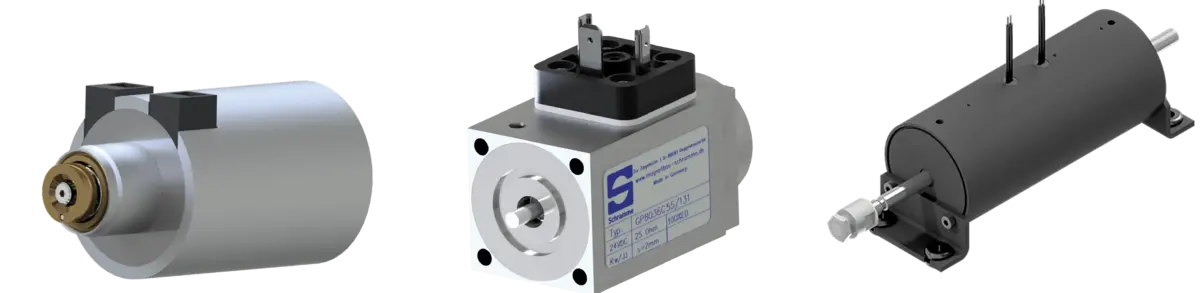
Integrated sensors: the data source for predictive maintenance
Today’s solenoid solutions often include built-in sensors—from temperature sensors to Hall sensors and current measurement. They continuously capture the actuator’s “health status” and provide the base data for predictive maintenance. With integrated stroke measurement (position sensing) and other sensors, solenoids effectively become “sensing actuators" [1]. Deviations from normal operation—such as higher temperature or incomplete stroke—are detected and reported immediately.
Example: In a chemical production environment, a proportional solenoid (a specialized solenoid for continuous valve control) regulates flow in a reaction system. This electric lifting solenoid features a temperature sensor on the coil and an integrated position sensor for the armature stroke. During operation, the coil temperature is observed to rise gradually—an indication that the solenoid is working against increased resistance (e.g., deposits in the valve). At the same time, the Hall sensor detects that the armature is no longer reaching the specified end stop, which should be at a 20 mm stroke. These deviations from the target state are reported to the control system long before the valve fails. The maintenance team can intervene early and clean the valve during the next planned shutdown. This prevents an unplanned failure and avoids interrupting production.
Lesson: Sensor-integrated solenoids deliver precise, real-time condition data about their own function. This makes it possible to detect wear or faults in advance—turning predictive maintenance into a plannable process. For plant operators, this means maintenance work can be targeted and preventive, before issues become critical. Decision-makers should prioritize actuators with integrated sensors in new purchases to establish the foundation for predictive maintenance from the start.
Networked solenoids in the IoT: real-time data and edge analytics
IoT-capable solenoids transmit sensor data to higher-level systems via standardized interfaces (e.g., IO-Link, CANopen, or Ethernet-based fieldbuses). In Industry 4.0, such actuators are part of connected systems in which sensors, actuators, and controllers communicate continuously. Edge analytics—decentralized data processing on the machine—makes it possible to evaluate high-frequency measurement data directly on site. This enables anomalies to be detected without delay and reduces load on the central network, since only relevant information is forwarded.
Example: A mid-sized machine builder upgraded its packaging lines with smart solenoids. These electromechanical actuators control, for example, flaps and singulation mechanisms and are connected to the PLC via IO-Link. With every stroke, the solenoid sends its measured values—current draw, position, temperature—to an edge controller located directly at the machine. There, specialized algorithms analyze the data in real time. Over time, the system shows, for example, that a specific spring-return solenoid gradually requires more current to achieve the same stroke. The local edge analytics recognizes this pattern and triggers an alert before the PLC reports a fault. The maintenance team replaces the affected actuator during scheduled service. Result: no unexpected line stoppage—even though a problem was already developing.
Lesson: Seamless IoT integration turns solenoids into valuable data providers for maintenance. Real-time monitoring at the machine—combined with intelligent analysis—dramatically increases response speed. Decision-makers should ensure new plants and machines use such connected actuators. Investing in interfaces and edge computing pays off by giving maintenance teams early, accurate insight into the condition of critical components.

AI-driven data analytics: detecting solenoid anomalies before downtime occurs
The real power of predictive maintenance becomes apparent when using AI and machine learning. Algorithms analyze the flood of sensor data and detect even the smallest deviations from a solenoid’s normal behavior. This reveals complex patterns in current curves, temperature trends, or motion profiles that indicate early-stage wear. In short: artificial intelligence detects anomalies before a human technician could even measure or see them.
Example: In an automotive manufacturer’s smart-factory production, an AI system monitors dozens of solenoid valves in the paint shop. Each of these valve solenoids opens and closes valves for paint and air supply thousands of times per day. A self-learning algorithm has learned the normal behavior of each solenoid coil (current draw, stroke time, magnetic force) based on historical data. One night, the AI detects an unusual pattern on one valve: the armature stroke is slightly delayed and the current curve shows minor irregularities—changes so small that a human operator would not have noticed them. The system interprets this as incipient wear either in the solenoid or in the valve itself and issues a maintenance recommendation. While production continues, the required spare part is prepared. During the next planned maintenance window, the team replaces the solenoid. A potential shutdown of the paint line was prevented through predictive analysis—without production or quality loss.
Lesson: ML-based anomaly detection turns large data sets into concrete maintenance predictions. Studies estimate the potential of this technology at up to 30% lower maintenance costs and 70% fewer failures [2] – a major lever for productivity and equipment availability. For industrial decision-makers, this means early investment in data-driven maintenance solutions and AI analytics pays off. Unplanned downtime becomes the exception, component service life increases, and overall equipment effectiveness (OEE) improves measurably.
Less downtime and lower costs: Impact on availability and TCO
Smart lifting magnets significantly increase plant availability while reducing the total cost of ownership (TCO) of industrial plants. By enabling predictive maintenance, unplanned production downtime can be reduced substantially – in practice, by up to 50%. At the same time, maintenance and follow-up costs decrease because potential damage is detected at an early stage and consequential damage is avoided. As a result, the additional investment in sensor technology and data analytics is usually amortised within a short period of time.
Example: A mechanical engineering plant manufacturer evaluated retrofitted sensor-based lifting magnets in its CNC machine tool production line. Within one year of the upgrade, unplanned downtime decreased noticeably. Previously, an unplanned machine stoppage occurred roughly once per quarter due to a defective magnetic actuator. After switching to intelligent industrial lifting magnet solutions, the production line operated for an entire year without a single actuator-related failure. Overall, unplanned downtime was reduced by almost half. Maintenance costs also declined, as interventions became more predictable and often less extensive. Plant availability improved by several percentage points – a direct contribution to productivity and a key factor in calculating lifecycle TCO.
Lesson: Investing in lifting magnet 4.0 technology delivers immediate benefits in the form of higher availability and lower operating costs. Decision-makers should therefore consider these advantages when developing plant strategies and making investment decisions. In tenders and technical specifications for future projects, it is advisable to define requirements such as integrated sensor technology, IoT interfaces and intelligent diagnostic capabilities for actuators. An experienced lifting magnet manufacturer like Magnetbau Schramme can provide customer-specific solutions and supports clients from the design phase onwards – for example with CAD models of lifting magnets for seamless integration. In short, companies that invest in smart lifting magnets today benefit in the long term from reduced downtime, optimised maintenance strategies and significantly lower overall costs.