

In food production, electromagnets drive precise processes and combine the highest standards of hygiene with reliable product safety.

Electromagnets in the Food Industry: Invisible Helpers for Greater Safety and Quality


Alexander Grischin
Sales Manager
Quicklinks
- Precision engineering behind hygienic food production
- Hygiene requirements in the food industry
- Electromagnetic actuators as key components
- Hygienic Design: Design for maximum food safety
- Typical applications for electromagnetic solutions
- New innovations in food automation
- Magnetbau Schramme’s role in this field of technology
- The future of electromagnetic actuators in the food industry
- Conclusion
- FAQ: Electromagnets in the food industry
Precision engineering behind hygienic food production
Modern food production is now highly automated. From raw material transport and processing to filling and packaging, complex machines and process systems operate continuously. At the same time, two key requirements must be met simultaneously: maximum efficiency and absolute product safety.
Many of the critical functions in such systems are controlled by electromagnetic actuators, including electromagnets, linear solenoids, proportional solenoids, switching solenoids, and solenoid valves. For example, they ensure that liquids are dosed precisely, valves open and close reliably, and mechanical movements are controlled with accuracy.
Although these components are often hidden inside machines, they play a central role in quality, hygiene, and process reliability in the food industry. In particularly sensitive areas such as dairy processing, beverage production, or baby food manufacturing, highly reliable electromagnetic actuation systems are indispensable.
Companies such as Magnetbau Schramme have been developing custom electromagnetic solutions for demanding industrial applications for many years – including projects for food technology, where hygiene, reliability, and fast development cycles are critical.
Hygiene requirements in the food industry
Food processing systems are subject to strict regulatory and hygienic requirements. International guidelines, such as those issued by the European Hygienic Engineering & Design Group (EHEDG), define clear requirements for the design, materials, and cleaning of system components. The goal is to prevent microbiological contamination and ensure safe production.
Valves and actuators in particular play an important role here, as they often come into direct contact with the product or are part of piping systems. Hygienic designs must therefore be engineered in such a way that no residues, bacteria, or product remnants can accumulate.
Typical requirements for components used in food processing systems include, for example:
- smooth surfaces with very low roughness
- avoidance of dead spaces and gaps
- durable materials such as 316L stainless steel
- easy cleaning through CIP or SIP processes
- resistance to aggressive cleaning chemicals
EHEDG guidelines emphasize that valves and solenoid valve actuators in particular are critical to the microbiological safety of a system. Faults or unsuitable designs can lead to contamination or production downtime.
Electromagnetic actuators as key components
In many process steps, electromagnetic actuators perform the actual mechanical work. Solenoid valves, linear solenoids and proportional solenoids are especially common.
Solenoid valves control the flow of liquids or gases. They open or close pipes within milliseconds, thereby enabling precise control of production processes. In automated systems, for example, they ensure that ingredients are dosed exactly or that cleaning solutions are directed into process lines with precision:
- pinch valves for the sterile control of liquid flows
- Seat valves and gate valves for hygienic process lines
- Double-stroke solenoids for safety-critical switching functions
- Proportional solenoids for precise flow control
- Holding solenoids for holding and positioning functions
In more complex systems, electromagnetic components are also combined with sensor technology and control systems. This creates intelligent actuation systems that automatically monitor and adjust process parameters.
Hygienic Design: Design for maximum food safety
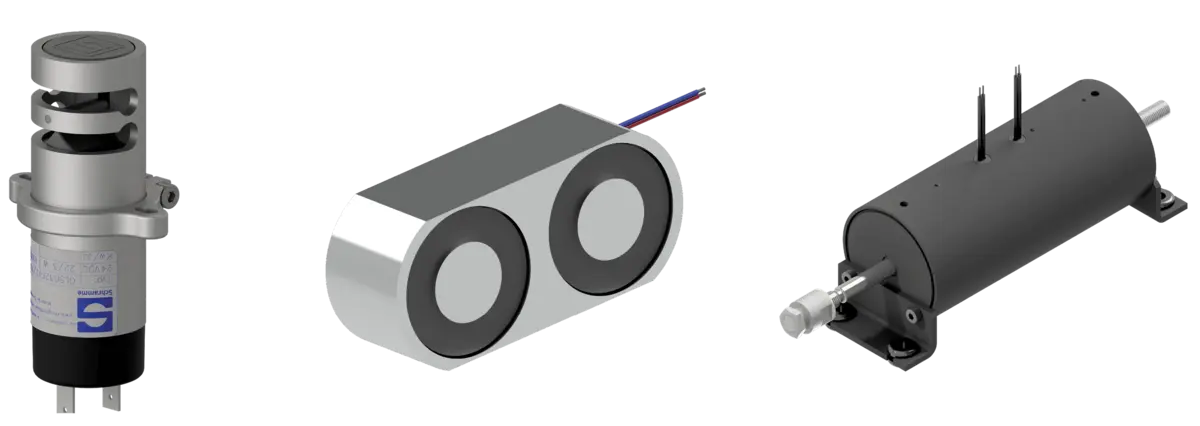
The design of electromagnetic components for food processing systems differs significantly from that of conventional industrial applications. In addition to functionality, Hygienic Design plays a particularly important role.
Hygienic machine components must be designed so that they are easy to clean and pose no microbiological risk. This applies not only to valve bodies or pipelines, but also to electromagnetic actuators.
One example is special hygienic valve designs in which product residues can barely adhere. Modern systems use optimized geometries or special valve blocks, for instance, that significantly reduce potential contamination zones and improve cleaning efficiency.
Magnetic separators are also increasingly being designed according to hygienic principles. New systems can remove even the smallest metallic particles from food while remaining fully cleanable. Stainless steel housings without gaps or weld seams prevent the formation of bacterial hotspots.
For developers of electromagnetic components, this means that in addition to electromagnetic properties, material selection, surface finishing, and sealing also play a central role.
Typical applications for electromagnetic solutions
Electromagnetic actuators are integrated at numerous points in modern food processing systems. They perform precise control and motion functions that are crucial for stable and repeatable production processes. Especially in automated production lines, electromagnets, linear solenoids, solenoid valves, and switching solenoids ensure that processes run reliably and with consistent repeatability.
Dosing and Filling Systems
Electromagnetically actuated valves play a central role in filling and dosing systems. Beverages, dairy products, sauces, or liquid ingredients must be filled into containers, bottles, or packaging with a high degree of accuracy. Even small deviations can lead to product loss, quality issues, or regulatory problems.
Solenoid valves with integrated valve solenoids are often used here. They open and close with very short response times, enabling precise control of liquid flows. In high-performance filling systems, these systems sometimes have to complete several million switching cycles per year reliably.
Applications involving viscous or particle-laden products are particularly demanding. In such cases, special seat valves or gate valves are often used, with their movement controlled by electromagnetic actuation systems. These valves must not only operate precisely, but also be designed for complete hygienic cleanability.
Processing and Mixing
In many production processes, ingredients are dosed and mixed with precision to ensure consistent product quality. Precise flow control is especially critical for recipes with multiple components – such as beverages, dairy products, or functional foods.
Proportional solenoids are often used here. Unlike conventional switching solenoids, they allow stepless control of valve positions. This makes it possible to adjust flow rates very finely and adapt them dynamically.
Such electromagnetic control valves are used, for example, in:
- dosing systems for flavorings or additives
- mixing processes for beverages or dairy products
- controls for pressure and temperature regulation loops
By combining proportional solenoids, sensor systems, and digital control, production plants can now maintain process parameters with very high precision.
Packaging Technology and Handling Systems
Electromagnetic actuators also play an important role in packaging technology. Packaging machines often operate at very high cycle rates while also having to execute precise movements.
In such machines, linear solenoids, double-stroke solenoids, or reversing linear solenoids perform a variety of functions, such as:
- positioning packaging films
- opening and closing gripper systems
- locking mechanisms in packaging stations
- ejecting or sorting packaging units
One advantage of electromagnetic actuators is their high dynamic performance and comparatively simple integration into automated machines. In addition, such systems can be designed very compactly – an important factor in modern, space-optimized production lines.
Conveying Technology and Drive Systems
In addition to valve control, electromagnetic systems are also used in conveying and drive systems. Here, electromagnetic clutches and brakes, for example, ensure that movements can be controlled precisely.
Such systems enable:
- controlled starting and stopping of conveyor belts
- precise positioning of products on production lines
- synchronization of different machine modules
In addition, holding magnets or special switching solenoids are also used to temporarily fix components in place or trigger mechanical processes.
Hygienic Hose Systems and Sterile Processes
In applications involving sensitive liquids – such as beverage production or fermented products – pinch valves are often used. These valves act externally on flexible hoses and therefore do not come into direct contact with the product.
Electromagnetically actuated pinch valves offer several advantages:
- sterile liquid transport
- minimal cleaning effort
- fast switching times
- easy integration into automated systems
Especially in systems with frequently changing recipes or short production cycles, such solutions can significantly increase process reliability.

New innovations in food automation
The food industry is currently undergoing profound technological change. Automation, digitalization, and rising hygiene requirements are driving the continuous development of electromagnetic actuators as well. Over the past two to three years in particular, several innovations have helped further improve the performance of such systems.
Intelligent Solenoid Valves and Condition Monitoring
A key trend is the integration of sensor technology and digital communication into electromagnetic actuators. Modern solenoid valves and valve solenoids can now be equipped with integrated sensors that continuously record important operating parameters.
Typical measured variables include, for example:
- current consumption of the solenoid coil
- coil temperature
- switching times and cycle counts
- mechanical motion profiles of the armature
This data is analyzed by control systems and enables predictive maintenance concepts. Maintenance measures can therefore be planned early, before an actual failure occurs.
Especially in large food production plants with several hundred valves, this technology can help significantly reduce unplanned downtime.
Energy-Efficient Solenoid Coils and Optimized Actuators
Another area of innovation concerns the energy efficiency of electromagnetic systems. New solenoid coil designs make better use of the available installation space while also reducing heat generation.
Technical progress results in particular from:
- optimized magnetic circuits
- improved winding technologies
- new ferromagnetic materials
- intelligent current control systems
Such developments are particularly relevant for systems with many electromagnetic actuators. Even small efficiency gains can lead to substantial energy savings in large production lines.
Hygienically Optimized Actuator Housings
Another innovation focus lies in Hygienic Design. New actuator housings are increasingly being engineered so that they are fully cleanable and do not allow dirt deposits to form.
Modern designs are characterized, among other things, by:
- fully enclosed housings
- smooth stainless steel surfaces
- reduced gap dimensions
- optimized sealing systems
These designs are specifically tailored to cleaning methods such as CIP (Cleaning in Place) and SIP (Sterilization in Place), which are regularly carried out in many food processing systems.
Miniaturization and Compact Actuators
Another important trend is the increasing miniaturization of electromagnetic components. Modern production systems are becoming ever more compact, which means that the installed actuators must also require less space.
New generations of linear solenoids, switching solenoids, and valve solenoids are therefore being developed specifically for very compact designs. At the same time, they must continue to deliver high forces and short switching times.
This development places high demands on design, material selection, and manufacturing technologies.
Connected Production Systems and Industry 4.0
Finally, digitalization is also playing an increasingly important role. Modern food processing systems are becoming more connected and continuously exchange data on production parameters.
Electromagnetic actuation systems are therefore being integrated more and more often into such digital production environments. They communicate with control units, sensors, and higher-level production systems.
Among other things, this connectivity enables:
- automated process optimization
- digital quality monitoring
- flexible adjustment of production parameters
- faster changeovers of production lines
Electromagnetic actuators are therefore becoming important building blocks of modern smart food factories.
Magnetbau Schramme’s role in this field of technology
The development and production of electromagnetic components for demanding industries requires not only technical expertise, but also experience in industrializing complex products.
Magnetbau Schramme has many years of expertise in developing custom electromagnets, valve solenoids, linear solenoids, and other electromagnetic actuation systems. Several projects for applications in the food industry have already been successfully implemented in recent years.
One key success factor is the ability to execute development projects very quickly. Customers benefit in particular from:
- short development times for new actuator solutions
- fast delivery of prototypes and functional samples
- efficient industrialization of new products
- high manufacturing quality in accordance with IATF 16949
Especially in custom applications where machine manufacturers require individual solutions, this combination of development speed and industrial-grade quality is crucial.
The future of electromagnetic actuators in the food industry
The food industry is currently undergoing a profound technological transformation. New dietary trends, rising quality standards and increasing levels of automation are driving growing demand for precise, hygienic and energy-efficient actuators.
Electromagnetic systems will play a central role in this. Particularly relevant in the future are:
- compact, energy-efficient solenoid valves
- intelligent proportional solenoids for precise process control
- connected actuation systems with integrated sensor technology
- hygienic miniature actuators for new production concepts
At the same time, the importance of sustainable production processes is growing. New systems must not only operate efficiently, but also conserve resources. Electromagnetic actuators with low energy consumption and long service life make an important contribution here.
Conclusion
Electromagnets are among the invisible yet indispensable helpers of modern food production. They control valves, dosing systems, and mechanical movements with high precision and make a decisive contribution to ensuring that production processes run safely, efficiently, and hygienically.
However, strict hygiene regulations, complex automation systems, and rising quality requirements make the development of such components demanding. Modern electromagnetic actuators must not only function reliably but also comply with hygienic design guidelines and be capable of integration into connected production systems.
Companies such as Magnetbau Schramme demonstrate that these challenges can be successfully mastered with the right combination of development expertise, manufacturing competence, and quality assurance.
Fast development processes, short sample delivery times, and efficient series production make it possible to create innovative electromagnetic solutions – working in the background to ensure that food is produced safely and processed reliably.
FAQ: Electromagnets in the food industry
1. Why are electromagnetic actuators particularly reliable in automated food processing systems?
Compared with pneumatic or hydraulic systems, electromagnetic actuators have a very simple mechanical structure. A typical electromagnet essentially consists of a solenoid coil, a ferromagnetic core, and a movable armature. Since there are only a few moving parts, there are fewer points subject to wear.
Especially in applications such as linear solenoids, switching solenoids, or solenoid valves, this means a long service life combined with low maintenance requirements. In industrial food processing systems, switching cycles in the range of several million cycles per year are not uncommon – electromagnetic actuators are particularly well suited to handling such loads.
2. What role does electromagnetic precision play in maintaining recipe consistency in food production?
In food production, compliance with exact recipes is crucial for product quality and consistency of taste. Even small deviations in ingredient dosing can affect a product’s texture, flavor, or shelf life.
This is where proportional solenoids or precisely controlled solenoid valves are often used. They enable very fine control of liquid or gas flows and therefore help ensure that ingredients can be dosed reproducibly. Especially in highly automated mixing and dosing systems, this electromagnetic precision is an important building block for stable production processes.
3. How do temperature differences in food processing systems affect electromagnets?
Large temperature differences are common in the food industry. While some processes take place at low temperatures – for example in milk or beverage processing – other areas of the plant operate at high temperatures, such as during sterilization processes.
Electromagnetic actuators must therefore be designed so that their solenoid coils, insulating materials, and housings continue to function reliably even under severe temperature fluctuations. Special winding insulation, temperature-resistant potting compounds, and optimized heat dissipation ensure that electromagnetic performance remains constant even under such conditions.
4. Can electromagnets help reduce production downtime?
Yes, electromagnetic actuators can make an important contribution to plant availability. Modern solenoid valves and actuation systems are often modular in design and can be replaced relatively quickly during maintenance.
In addition, simple electromagnetic operating principles allow for good diagnosability. Changes in an actuator’s power consumption or switching time, for example, can provide early indication of wear or functional problems. This makes it possible to plan maintenance more precisely and reduce unplanned downtime.
5. Why are electromagnets often used in safety-critical functions?
Many food processing systems include safety-relevant functions, such as emergency shutdowns, interlocks, or product diverters. Electromagnetic actuators are well suited to such applications because they respond quickly and switch reliably.
Switching solenoids, double-stroke solenoids, or holding magnets in particular are often used in safety-relevant mechanisms. They can trigger mechanical movements precisely or reliably hold components in position. Suitable spring mechanisms also make it possible to implement fail-safe concepts in which a system automatically returns to a safe position in the event of a power failure.
6. What role do electromagnets play in the traceability of production processes?
Traceability is a key component of modern food production. Production processes must be documented so that rapid action can be taken in the event of quality problems.
Electromagnetic actuators can form part of such digital process chains. In modern systems, the switching states of solenoid valves, valve solenoids, or other electromagnetic actuation systems are often recorded and logged via control systems. This makes it possible to trace exactly which process steps were executed, when, and under what conditions.
7. What advantages do electromagnets offer over pneumatic systems in food processing plants?
Pneumatic systems have traditionally been used frequently in production plants. However, electromagnetic actuators offer several advantages, especially in precise or fast-cycling applications.
Electromagnetic systems do not require a compressed air supply and therefore operate independently of compressors or compressed air lines. In addition, linear solenoids, proportional solenoids, or switching solenoids can be actuated very quickly and precisely. This can be particularly decisive in highly automated machines or in applications with short switching times.
8. How do electromagnetic actuators influence the energy efficiency of production systems?
The energy consumption of production systems is playing an increasingly important role – both economically and ecologically. Electromagnetic actuators can contribute to optimization here.
Modern solenoid coils are designed to operate with the lowest possible power consumption. At the same time, precisely controlled solenoid valves or proportional solenoids make it possible to regulate processes very accurately. This can help prevent overdosing or unnecessary process steps, for example, which in turn saves energy.
9. In which areas of food production are especially robust electromagnets required?
Certain production environments place particularly high demands on electromagnetic actuators. These include, for example, systems in which:
- high humidity is present
- aggressive cleaning agents are used
- strong vibrations occur
- large temperature fluctuations are present
In such applications, electromagnets, valve solenoids, or other electromagnetic components must be designed to be especially robust. Corrosion-resistant materials, sturdy housings, and suitable sealing systems ensure that the actuators continue to function reliably even under such conditions.
10. What role do custom electromagnetic solutions play in the food industry?
Many production systems in the food industry are highly specialized. Standard components are therefore often not sufficient to meet all technical requirements optimally.
Custom-developed electromagnetic actuation systems make it possible to tailor actuators exactly to the respective application – for example in terms of size, magnetic force, switching time, or integration into valve systems. Especially in complex machines or innovative production concepts, such tailored solutions can offer decisive advantages.
Companies with experience in developing custom electromagnets, linear solenoids, or solenoid valves support machine manufacturers in implementing new production solutions efficiently.
If you want, I can also put this into a clean Word-ready format with standardized terminology choices throughout (for example, using either linear solenoid or push-type solenoid consistently).